
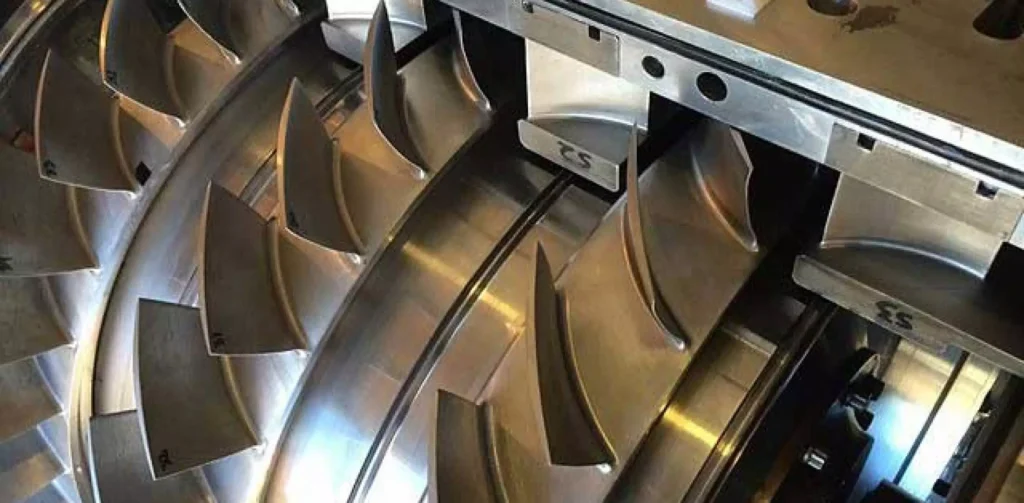
CNC multi-step finishing has become a cornerstone in the production of heat-resistant turbine shroud segments, particularly in aerospace propulsion, industrial gas turbines, and next-generation energy systems. These shrouds operate in one of the harshest thermal environments found in mechanical engineering, often reaching temperatures exceeding 1,400°C depending on engine class and fuel composition. As a result, the materials used—such as nickel-based superalloys, ceramic matrix composites, directionally solidified alloys, and thermal-barrier–coated substrates—are specifically engineered to withstand high oxidation, thermal fatigue, and extreme vibratory loading. However, these same advanced materials introduce immense machining challenges. High hardness, abrasive grain structure, and low thermal conductivity interfere with surface finishing, tool longevity, and dimensional stability. To meet stringent aerodynamic and thermal requirements, turbine shrouds must undergo multi-step CNC finishing sequences that balance high-precision geometry, micro-level surface texture, and thermal coating compatibility. With search engines increasingly favoring content that emphasizes topical authority, technical relevance, and user-intent clarity, a deep exploration of multi-step finishing processes aligns with the evolving digital landscape and supports manufacturers seeking optimized workflows.
The foundation of CNC multi-step finishing for turbine shroud segments lies in the segmentation of machining operations into logically structured, low-force material removal stages. Instead of relying on a single finishing pass, manufacturers deploy a tiered approach—semi-finishing, precision finishing, contour blending, and micro-polishing—to progressively refine the geometry while minimizing heat buildup and tool wear. Semi-finishing operations aim to remove residual stock left from roughing while stabilizing dimensional features such as honeycomb interfaces, tip seal grooves, and mounting rails. Using optimized step-down parameters and adaptive engagement toolpaths, semi-finishing removes heat-affected zones created during prior machining stages. Precision finishing then focuses on the complex aerodynamic contours responsible for regulating turbine blade tip leakage and maintaining engine efficiency. During this stage, CNC machines rely heavily on multi-axis interpolation, high-resolution encoders, and real-time tool deflection compensation to maintain sub-20-micron tolerances. For turbine shrouds equipped with thermal-barrier coatings, finishing sequences must also anticipate coating thickness and surface roughness targets, ensuring the pre-coat geometry is perfectly aligned with the final design intent. These multi-step processes not only enhance surface continuity but also reduce stress concentrations that may contribute to fatigue cracking during high-cycle engine operation.
Tooling selection is equally crucial in multi-step finishing because turbine shroud materials require tools that can tolerate extreme abrasion and resist thermal degradation. Polycrystalline diamond (PCD), cubic boron nitride (CBN), and ceramic-coated carbide tools form the backbone of finishing operations, each selected based on material hardness, coating type, and specific geometry. PCD tools excel in producing ultra-smooth surfaces on ceramic matrix composites, while CBN tools maintain cutting-edge sharpness during high-speed finishing of nickel-based superalloys. Carbide end mills with advanced nanocomposite coatings—such as AlTiN, TiAlN, and AlCrN—provide exceptional heat resistance and exhibit minimal edge rounding during prolonged finishing cycles. Optimized helix angles, variable flute geometry, and mirror-finished cutting edges reduce frictional heat and facilitate responsive chip evacuation. When dealing with honeycomb shroud segments, manufacturers often employ miniature ball-end mills and lollipop cutters to machine complex recesses while minimizing part distortion. The combination of advanced tooling science and multi-step machining ensures the final turbine shroud profile delivers optimal aerodynamic performance, reduced blade-tip leakage, and superior thermal endurance throughout the turbine’s operational lifespan.
Thermal management strategies significantly influence both the efficiency and integrity of multi-step CNC finishing. Since heat-resistant turbine shroud segments inherently trap heat during machining, temperature control must be integrated into every finishing stage. High-pressure coolant systems and through-spindle coolant delivery play a pivotal role in dissipating heat from the cutting zone while stabilizing the microstructure of the superalloys. In high-speed finishing operations, coolant atomization and minimum-quantity lubrication systems reduce thermal shock and help maintain predictable tool wear patterns. Cryogenic machining—using liquid nitrogen to cool the cutting edge—has become increasingly valuable for finishing nickel-based superalloys, as it lowers workpiece temperature without causing structural stress or altering the metallurgical properties of thermal barrier coatings. Additionally, thermal compensation algorithms in modern CNC machines eliminate errors arising from spindle expansion, axis drift, and prolonged thermal soak cycles. These algorithms use real-time sensor data to adjust toolpath trajectories and maintain strict dimensional accuracy even during extended multi-pass finishing operations. Such thermal control ensures surface quality, coating adhesion readiness, and geometric stability, all of which directly influence turbine shroud durability and in-service performance.
Equally important to the finishing process is machine stability and process control, which ensure predictable results across multiple turbine shroud segments. High-stiffness machine designs, active vibration damping, linear motor drives, and precision ball screws eliminate micro-vibrations that could cause surface waviness or edge chipping. Multi-axis machines—such as 5-axis simultaneous milling centers—enable continuous tool orientation adjustment, providing access to difficult contours while enhancing surface smoothness. In-process metrology techniques such as probing cycles, laser measurement systems, and non-contact scanning verify geometric conformity at different finishing stages. Adaptive control technology further refines the finishing process by automatically adjusting feed rates, spindle speeds, and tool engagement levels based on real-time cutting conditions. These intelligent adjustments prevent excessive tool load, stabilize surface finishing behavior, and improve consistency across large production batches. For turbine shrouds used in high-performance aircraft engines, such levels of process predictability are essential, as any deviation in surface texture or dimensional accuracy may negatively impact engine efficiency, fuel consumption, and thermal stability.
Looking ahead, CNC multi-step finishing processes for heat-resistant turbine shroud segments are undergoing rapid evolution driven by digital manufacturing technologies, hybrid machining workflows, and AI-based decision-making tools. Digital twins now allow manufacturers to simulate entire finishing workflows before machining begins, predicting distortion patterns, tool wear progression, and surface error accumulation with remarkable accuracy. AI-enhanced CAM algorithms generate optimized finishing toolpaths that balance surface integrity, thermal control, and machining efficiency. Hybrid systems combining additive manufacturing and subtractive finishing produce near-net-shape turbine shroud segments with reduced stock allowance, significantly lowering machining time. Emerging laser-assisted finishing techniques soften material surfaces during cutting to reduce tool wear, while ultrasonic vibration-assisted milling further enhances surface quality in ceramic matrix composites. As search algorithms increasingly reward authoritative, comprehensive, and user-centric content, presenting an in-depth analysis of finishing processes positions this subject as a high-value technical resource. Ultimately, mastering CNC multi-step finishing is not simply about achieving a smooth surface—it is about delivering precision-engineered turbine shroud segments that uphold performance, efficiency, and safety in some of the most extreme technological environments on Earth.