
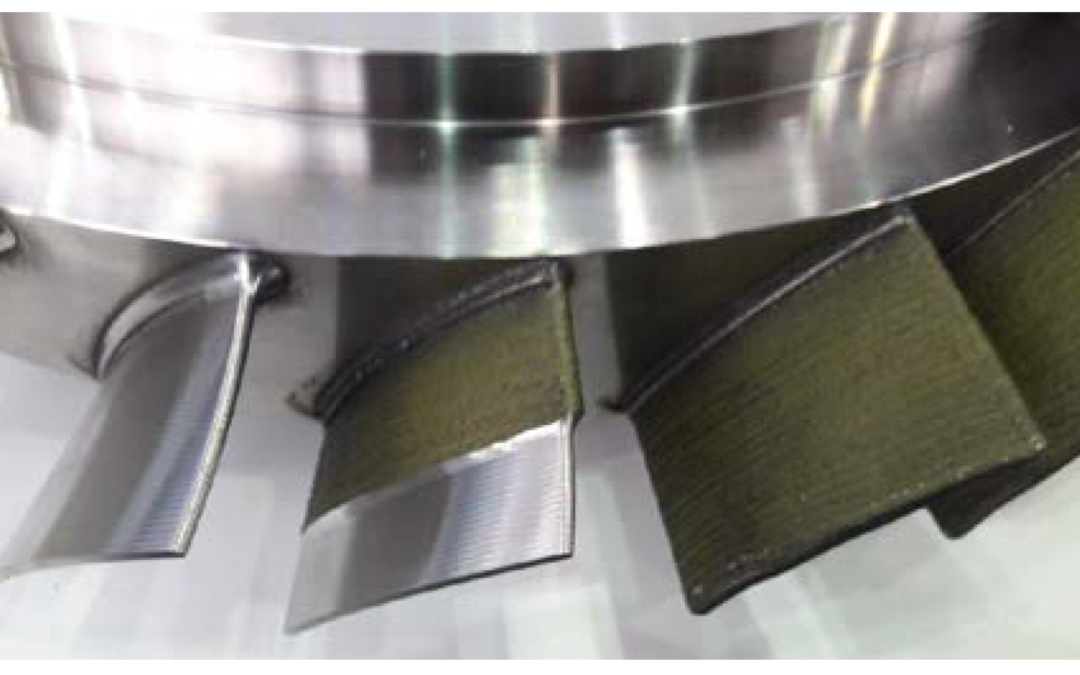
CNC high-speed contour roughing has become a defining capability in modern aerospace machining—especially when working with titanium compressor blade roots, where structural integrity and aerodynamic performance depend on precision at every stage. As aerospace manufacturers push for lighter, stronger, and more efficient engines, titanium remains the material of choice for many high-stress components. However, its low thermal conductivity, high strength, and tendency to work-harden make machining extremely challenging. That is why optimized high-speed contour roughing strategies are essential not only for stable machining, but also for extending tool life, improving cycle times, and ensuring repeatable part quality. In today’s competitive environment, the goal is to achieve predictable machining outcomes while maintaining tight tolerances across complex organic geometries.
The effectiveness of CNC high-speed contour roughing lies in its ability to use dynamic toolpaths that reduce cutting forces and maintain consistent chip loads. Unlike traditional roughing, which relies on heavy step-down cuts that increase vibration, heat, and premature tool wear, high-speed strategies apply controlled engagement to minimize stress on the cutter. For titanium compressor blade roots—where any geometric inconsistency can affect engine balance and airflow—this approach significantly improves accuracy. Modern CAM software now integrates adaptive milling algorithms that calculate optimal tool engagement angles, allowing machinists to safely increase feed rates without compromising part quality. Such processes deliver smoother transitions along contoured surfaces and help ensure that the remaining stock for finishing is uniform and predictable.
Aerospace components like compressor blade roots require not just speed but also exceptional stability. High-speed contour roughing supports these requirements through toolpaths that preserve radial chip thinning, resulting in lower spindle loads and improved thermal distribution. This is particularly critical for titanium, which tends to trap heat at the cutting zone. By reducing heat accumulation, machinists can mitigate the risk of micro-cracking, distortion, or metallurgical changes. The use of coated carbide end mills—engineered with heat-resistant nano-coatings—further enhances performance by providing better lubrication and wear resistance. Combined with rigid fixturing and five-axis simultaneous motion, the machining process can maintain higher accuracy during aggressive roughing operations.
Another key advantage of advanced high-speed contour roughing is its ability to reduce machining time without compromising component durability. For large production batches, even small reductions in cycle time translate into significant cost savings and throughput improvements. With optimized step-over values, constant cutter engagement, and strategically designed toolpaths, manufacturers can remove large amounts of titanium faster while maintaining tighter control over surface integrity. This sets the foundation for subsequent semi-finishing and finishing stages, where more delicate contours and root fillets are machined to final tolerance. In aerospace environments where compliance and consistency matter, such efficiency is essential for meeting strict certification requirements.
The evolution of real-time monitoring and machine-learning-driven optimization further enhances high-speed contour roughing. New-generation CNC controls are capable of automatically adjusting feed rates, spindle speeds, and toolpath parameters based on live feedback. This makes machining titanium compressor blade roots not only more predictable but also more adaptive to tool wear, temperature changes, and machine vibrations. As predictive analytics and digital twins become standard across aerospace manufacturing, high-speed contour roughing strategies will continue to evolve, offering greater accuracy, reduced downtime, and improved process repeatability. The ability to simulate tool deflection, cutting heat, and torque loads ensures that manufacturers can validate machining strategies before committing to production, thereby reducing scrap and ensuring the highest possible standard of component reliability.
In a market where aerospace engine manufacturers demand exceptional precision and structural integrity, CNC high-speed contour roughing stands out as a critical capability. It combines high material removal rates with advanced control over cutting dynamics, making it ideal for machining titanium compressor blade roots with minimal risk and maximum efficiency. By leveraging adaptive toolpaths, thermal-stable machining strategies, predictive control systems, and next-generation carbide tooling, manufacturers can consistently deliver components that meet the strictest aerospace standards. As CNC technologies continue to advance, the future of titanium machining will revolve around deeper automation, smarter optimization, and increasingly precise roughing strategies—ultimately enabling lighter, more efficient, and more powerful aircraft engines.