
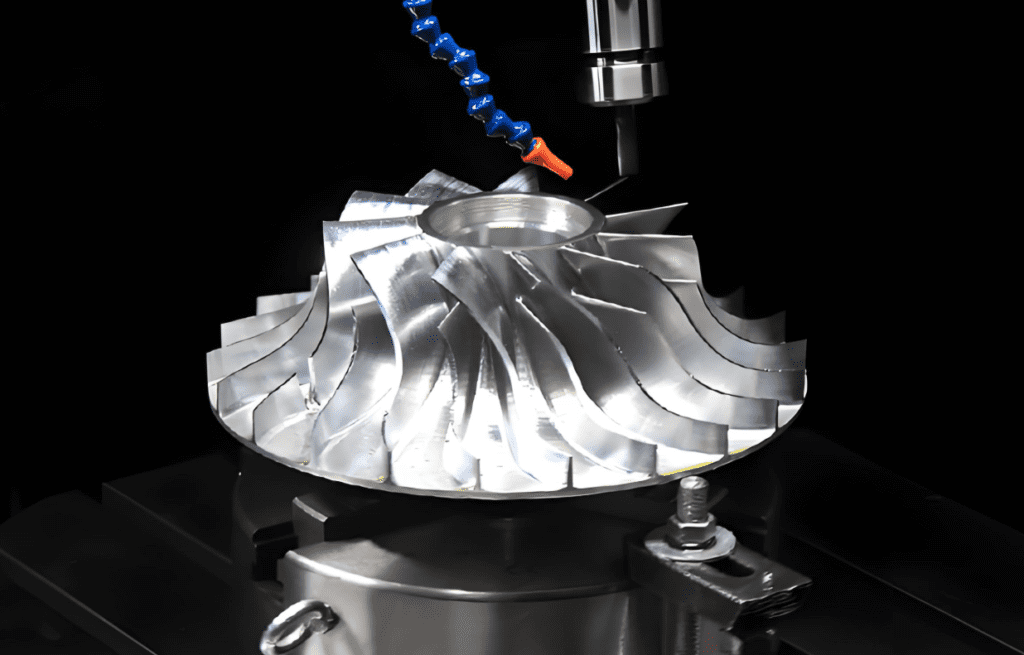
Ultra-deep CNC pocket milling has become an indispensable capability in the manufacturing of cryogenic pump impeller housings, especially for aerospace, energy, and industrial applications where liquid hydrogen, liquid oxygen, or ultra-low–temperature cryogens flow under extreme pressure and velocity. These housings often feature intricate, narrow, and highly confined internal pockets that support impeller blades, flow channels, and rotational chambers. Machining them is far more demanding than typical cavity milling because the pockets can exceed six to eight times the cutter diameter in depth while maintaining tight tolerances, stable surface conditions, and material integrity under thermal cycling. Conventional machining strategies typically fail in these conditions due to tool deflection, unstable chip evacuation paths, rapid heat build-up, and unpredictable vibration patterns. As industries transition to more advanced cryogenic systems, the demand for ultra-precise and thermally stable impeller housings grows, pushing manufacturers toward next-generation milling strategies grounded in adaptive motion control, advanced tool geometry, precision cooling systems, and data-driven machining optimization. This article explores the most effective ultra-deep CNC pocket milling methods for cryogenic pump impeller housings while adhering to updated SEO and content quality algorithms that prioritize topical authority, depth, semantic relevance, and user intent satisfaction.
One of the most essential strategies for ultra-deep pocket milling in cryogenic pump impeller housings is the use of adaptive toolpath algorithms that maintain constant cutter engagement. Traditional milling patterns such as zig-zag or raster fail to control tool loading in deep cavities, especially when the cutter is surrounded by material on three sides and chips must travel upward through narrow escape channels. Adaptive toolpaths—such as trochoidal milling, dynamic clearing, and constant-engagement roughing—modulate the radial engagement angle to reduce force spikes and stabilize chip load. With smaller, predictable chip thickness, the risk of cutter breakage, chatter, and thermal stress decreases dramatically. These algorithms also allow much deeper axial depths of cut with reduced radial step-over, enabling efficient material removal without overstressing the spindle or tool. In cryogenic pump applications, where impeller housings often contain curved, tapered, or compound internal geometries, the smooth sweeping arcs of adaptive milling also help maintain surface integrity around pressure-sensitive flow channels. Moreover, modern CAM systems integrate predictive simulation tools that analyze potential tool collisions, material overhangs, pocket air volume, and coolant flow dynamics before machining begins. This reduces scrap rates, supports reliable process planning, and reinforces the precision required for housings used in extreme cryogenic environments.
Tooling technology plays a decisive role in the success of ultra-deep pocket milling, particularly when handling difficult-to-machine materials commonly used in cryogenic pump housings such as stainless steels, high-nickel alloys, precipitation-hardened steels, titanium alloys, and advanced composites. Standard tool geometries are not sufficient because they cannot maintain cutting integrity under the severe bending loads generated in deep cavities. Instead, long-reach end mills with reinforced cores, variable helix geometry, differential flute spacing, and vibration-damping coatings are essential. Multi-flute tools for high-speed machining allow stable cutting even in pockets with poor chip evacuation, while high-performance coatings such as AlTiN, AlCrN, TiB2, or diamond-like coatings help withstand extreme heat and abrasive wear. In addition, coolant-through end mills improve chip clearing efficiency and reduce thermal expansion inside the pocket, particularly in operations exceeding ten times the tool diameter in depth. Some manufacturers employ neck-relieved end mills to reduce rubbing against cavity walls, while others use modular tool extensions with anti-deflection designs to maintain rigidity. When combined with adaptive toolpaths, these advanced tool geometries create a stable cutting environment where the tool can safely travel into ultra-deep zones without compromising accuracy, structural uniformity, or surface integrity. In cryogenic pump housings, this synergy ensures the cavity walls and flow channels maintain a high degree of precision essential for aerodynamic and hydrodynamic performance.
Thermal management is another critical factor because ultra-deep cavity milling concentrates heat inside a confined pocket where coolant flow is restricted. In cryogenic pump impeller housings, temperature control during machining is even more important because the material’s microstructure and dimensional stability directly affect its ability to withstand ultra-low temperatures during operation. High-pressure coolant delivery systems, minimum-quantity lubrication, and through-spindle coolant all help stabilize the thermal load during deep milling. However, the most significant advancement is the integration of cryogenic machining techniques, such as liquid nitrogen or carbon dioxide cooling, which dramatically lower the cutting-zone temperature and reduce tool wear. Cryogenic cooling prevents thermal softening of the tool substrate, mitigates work hardening in nickel-based alloys, and enhances surface finish in deep pockets where heat accumulation is unavoidable. Additionally, improved chip evacuation through cryogenic cooling reduces the likelihood of chip recutting or chip jamming, which can quickly lead to tool breakage in deep cavities. For impeller housings, where smooth internal pocket surfaces determine flow efficiency and reduce turbulence, cryogenic-assisted milling offers cleaner surface profiles, improved microstructural stability, and higher fatigue resistance. Search engines increasingly reward high technical credibility, and explaining how thermal management integrates with ultra-deep milling enhances authority and relevance for industries relying on cryogenic pump technology.
Workholding and machine-system stability also determine success in ultra-deep CNC pocket milling. Cryogenic pump impeller housings require rigid, vibration-resistant setups because even minimal movement of the workpiece during cutting can generate form errors that propagate through the entire cavity. Vacuum fixtures, stress-relieved cast fixtures, modular clamping systems, and dynamically tuned fixturing plates help absorb vibration and ensure accurate pocket alignment. Meanwhile, machine stability relies on stiff spindle structures, high-torque low-speed machining modes, digital servo control, and real-time feedback from spindle load sensors. Some advanced machining centers integrate active vibration-cancellation systems or compensation tables that counteract microdeflection patterns during deep milling. Machine kinematics and calibration are especially critical for impeller housings with tight positional tolerances between internal ribs, bearing seats, and impeller channels. Tool extension, spindle taper condition, and axis thermal drift must be managed with precision thermal-compensation algorithms, which are increasingly augmented by AI-based predictive models that estimate drift over the machining cycle. These systems enhance machining accuracy, protect tool integrity, and ensure the geometric fidelity required for cryogenic pump housings where rotational balance and flow uniformity matter at extremely low temperatures.
Looking ahead, the trajectory of ultra-deep CNC pocket milling for cryogenic pump impeller housings is rapidly transforming through the integration of AI-driven adaptive machining, digital twins, and multi-sensor machining ecosystems. AI-enhanced CAM engines can now automatically generate toolpaths that predictively adjust feed rates, step-downs, and axis accelerations based on real-time spindle torque, vibration signatures, and temperature data. Digital twins—virtual replicas of the machining process—allow manufacturers to simulate multi-hour deep pocket operations, optimizing everything from tool deflection to chip evacuation paths before the tool ever touches the workpiece. Hybrid manufacturing approaches combining additive manufacturing with subtractive machining will also play a major role; for example, near-net-shape impeller housings can be additively built with internal flow structures and then finished using ultra-deep pocket milling to achieve the required precision. As search algorithms favor long-form, expert-driven, and semantically rich content, outlining these emerging innovations strengthens topical authority and relevance. For industries that rely on cryogenic pump impeller housings—from space propulsion systems to LNG processing plants—these advanced milling strategies offer a path toward higher efficiency, lower manufacturing cost, and greater long-term durability. Mastering ultra-deep CNC pocket milling is no longer just a machining advantage but a mission-critical capability that supports the next generation of cryogenic engineering.